
5 Signs You Might Benefit From TMS Therapy
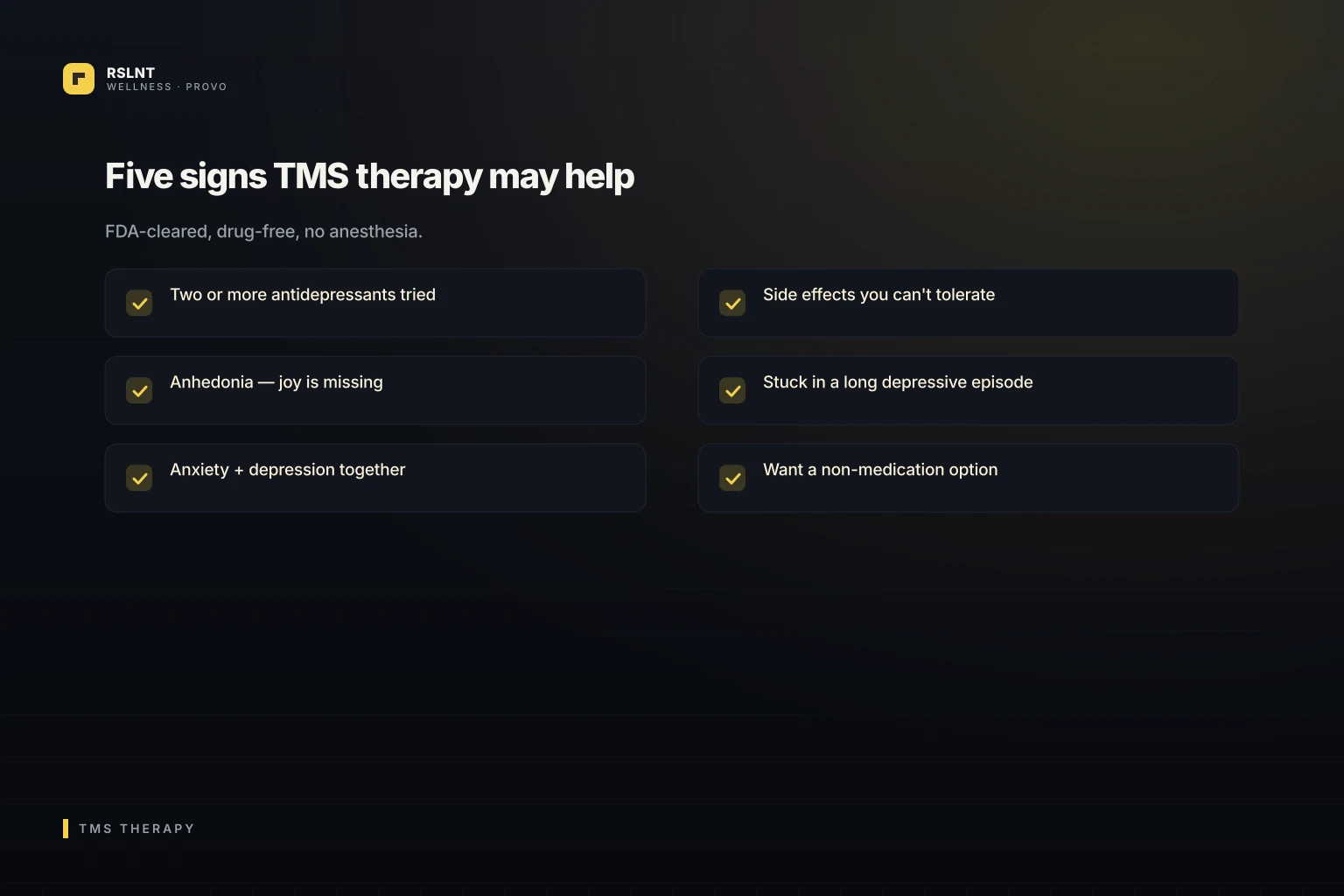
Table of contents
- You've tried two or more antidepressants and they didn't move much
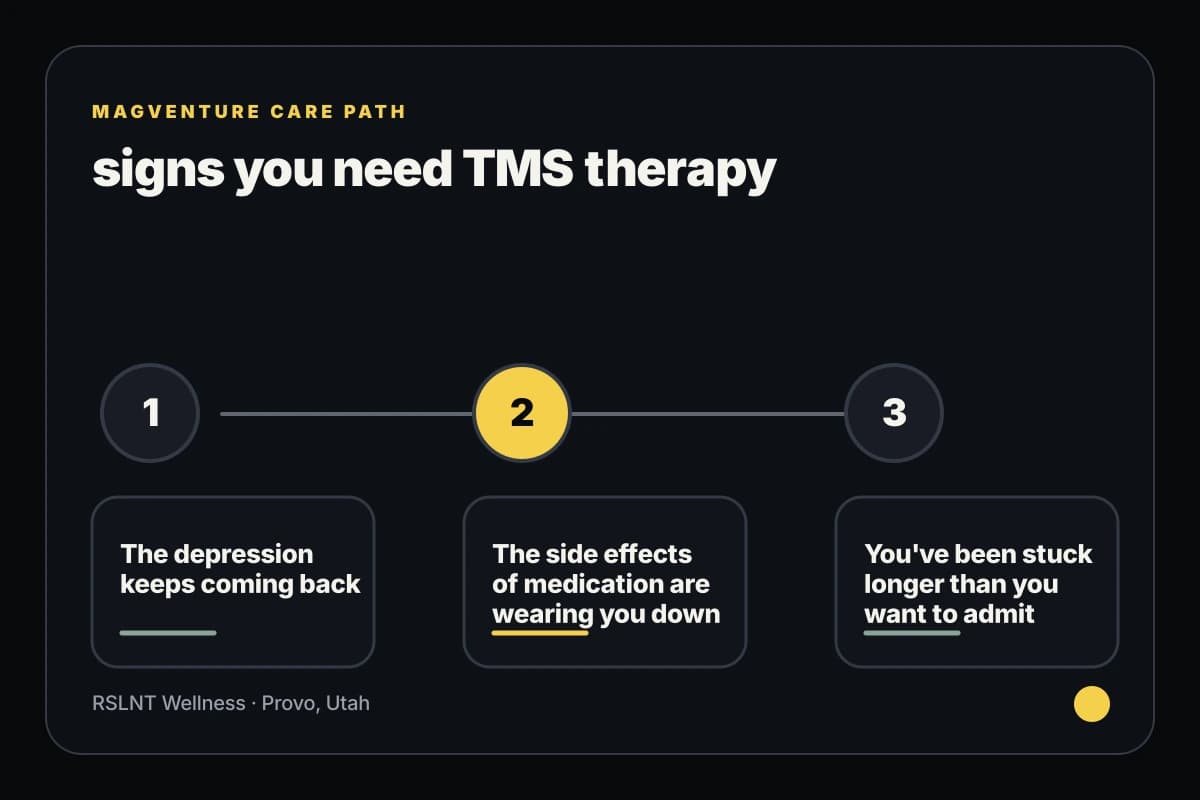
- The depression keeps coming back
- The side effects of medication are wearing you down
- You've been stuck longer than you want to admit
- You can feel something is off in your wiring, not just your thoughts
- How we actually treat this at RSLNT
- Frequently asked questions
- Ready to find out if you're a candidate
You've been on the medication. You've sat across from the therapist. You've done the journals, the breath work, the gratitude lists. And you still wake up most mornings feeling like somebody dimmed all the lights.
That's not failure. That's a signal your brain needs a different kind of help.
You may benefit from TMS therapy if standard antidepressants haven't worked, your depression keeps coming back, side effects from medication are wearing you down, you've been low for more than two years, or you can feel something is off in your wiring and not just your thoughts. TMS is FDA-cleared, drug-free, and works on the part of the brain that controls mood.
You've tried two or more antidepressants and they didn't move much
The American Psychiatric Association has a name for this. They call it treatment-resistant depression. About one in three adults with major depressive disorder don't get full relief from the first two medications they try.
If that's you, you're not picking the wrong pills. Your brain is doing something more complicated than serotonin levels. Sertraline, escitalopram, fluoxetine, bupropion. You can rotate the alphabet and still wake up tired.
TMS works because it skips the bloodstream. It uses magnetic pulses to wake up the part of the brain that handles mood, the left dorsolateral prefrontal cortex. No pill has to cross any barrier. The signal goes straight in.
The depression keeps coming back
You felt good for a few months. Then something happened, or nothing happened, and you're right back where you started. That cycle is exhausting.
Recurrent depression is real. The National Institute of Mental Health says more than half of people who have one depressive episode will have another. After two, the odds keep climbing.
TMS isn't just an emergency tool. For some patients, a maintenance round once or twice a year keeps the depression from settling back in. We've seen that pattern with our own patients in Provo, Orem, and across Utah County.
The side effects of medication are wearing you down
Weight gain. Numbness. The bedroom got quiet. Your hands shake. You can't remember the last time you cried at something you should've cried at.
Antidepressants save lives. They have a real place. But sometimes the cost of staying on them is high and the relief is partial. You don't have to keep paying that price if your body keeps telling you it's too much.
TMS has none of those side effects. The most common complaint is mild scalp tenderness during the first week of sessions and a tension headache that fades with a Tylenol. That's it.
You've been stuck longer than you want to admit
Two years. Five. Ten. You've told yourself it's just life. Just stress. Just the season you're in. But the season won't change.
Long, low-grade depression has its own name. Persistent depressive disorder. Sometimes called dysthymia. It's quieter than major depression. It doesn't look like a crisis. It looks like flat. Beige. Waking up and not being excited about anything.
TMS reaches that part of you. Patients with chronic depression often see the biggest jumps, because the brain has been so flat for so long that even small upticks feel huge.
You can feel something is off in your wiring, not just your thoughts
This is the sign nobody talks about. Sometimes you can tell it's not psychological. It's electrical. You're not thinking sad thoughts on purpose. The volume is turned wrong somewhere upstream of your conscious mind.
If that's how it feels, listen to it. Your gut is reading something real.
The FDA cleared TMS for major depressive disorder in 2008 and for OCD in 2018. It's been studied for almost two decades. It's not voodoo. It's how the brain responds when you give it the right kind of stimulus.
How we actually treat this at RSLNT
At RSLNT Wellness, we don't push TMS at the door. We listen first.
Counseling that's actually useful. Our clinicians use cognitive behavioral therapy and acceptance and commitment therapy. Both are evidence-based and give you tools you can use the same week. We also work with trauma-focused approaches when the depression is downstream of something older.
Medication management with a real human watching. We don't write a prescription and send you off. We adjust, we check in, we change course when something isn't working. SSRIs like sertraline and escitalopram, SNRIs like venlafaxine, and others all stay on the table.
TMS therapy when it's the right fit. We screen carefully. TMS is for people who've tried other treatments without enough relief. Most courses run about six weeks, five days a week for the first month. You sit in a chair, read or scroll your phone, and go back to your day.
The right answer might be one of these. It might be all three at once. We figure that out with you, not for you.
Frequently asked questions
Does insurance cover TMS therapy in Utah?
Most major plans in Utah cover TMS for treatment-resistant depression. SelectHealth, Regence, Cigna, Aetna, United, and most Medicare plans approve it when you've tried at least two medications. We handle the prior authorization paperwork, which usually takes one to two weeks.
How fast does TMS actually work?
Some patients feel a small lift in the first two weeks. The bigger shift usually lands between weeks three and five. By the end of the six-week course, most patients see a meaningful drop in their depression scores.
What happens if TMS doesn't work for me?
About 60 to 65 percent of patients respond to TMS. If you're in the group that doesn't, we don't drop you. We talk through other options, which might be a different combination of medication and therapy, or a referral if you need a higher level of care.
Ready to find out if you're a candidate
You don't have to keep guessing. A short call can tell us a lot.
Schedule a free 15-minute consult. We'll ask about your history, what you've tried, and what's still hard. If TMS makes sense, we'll walk you through what comes next. If it doesn't, we'll tell you that too.
I'm not a therapist or a doctor. I'm someone who went from suicidal ideation, major depressive disorder, and crippling anxiety to clarity of mind. I feel like I got my life back. RSLNT Wellness is the place that helped me get there. If you're struggling, you don't have to figure this out alone.
Frequently Asked Questions
Does insurance cover TMS therapy in Utah?
How fast does TMS actually work?
What happens if TMS doesn't work for me?
Sources & Further Reading
Every clinical claim in this article is backed by a public, peer-reviewed, or government source. We do not cite anything we cannot link to.
- [1]Transcranial magnetic stimulation - Mayo ClinicMayo ClinicBacks: TMS is a noninvasive treatment that uses magnetic fields to stimulate nerve cells in the brain.
- [2]Transcranial magnetic stimulation - Mayo ClinicMayo ClinicBacks: TMS is generally used when other depression treatments haven't been effective.
- [3]510(k) Premarket NotificationU.S. Food and Drug Administration · 2008Backs: The NeuroStar TMS Therapy System was FDA-cleared in 2008 for major depressive disorder.
- [4]FDA permits marketing of transcranial magnetic stimulation for treatment of obsessive compulsive disorderU.S. Food and Drug Administration · 2018Backs: The FDA permitted marketing of TMS for obsessive compulsive disorder in 2018.
- [5]Persistent Depressive DisorderMedlinePlusBacks: Persistent depressive disorder is a chronic form of depression lasting for years.
- [6]DepressionNational Institute of Mental HealthBacks: Depression can return after recovery, and prior episodes raise risk of future episodes.
- [7]What is Transcranial Magnetic Stimulation? (TMS)American Psychiatric AssociationBacks: TMS side effects commonly include scalp discomfort, facial tingling, and lightheadedness.
- [8]Transcranial magnetic stimulation - Mayo ClinicMayo ClinicBacks: TMS does not require anesthesia or sedation, and patients can return to usual activities afterward.
Ready to feel like yourself again?
Schedule a free consultation to see if TMS therapy is right for you.
Book Your Consultation