
How to Know If You Have Trauma
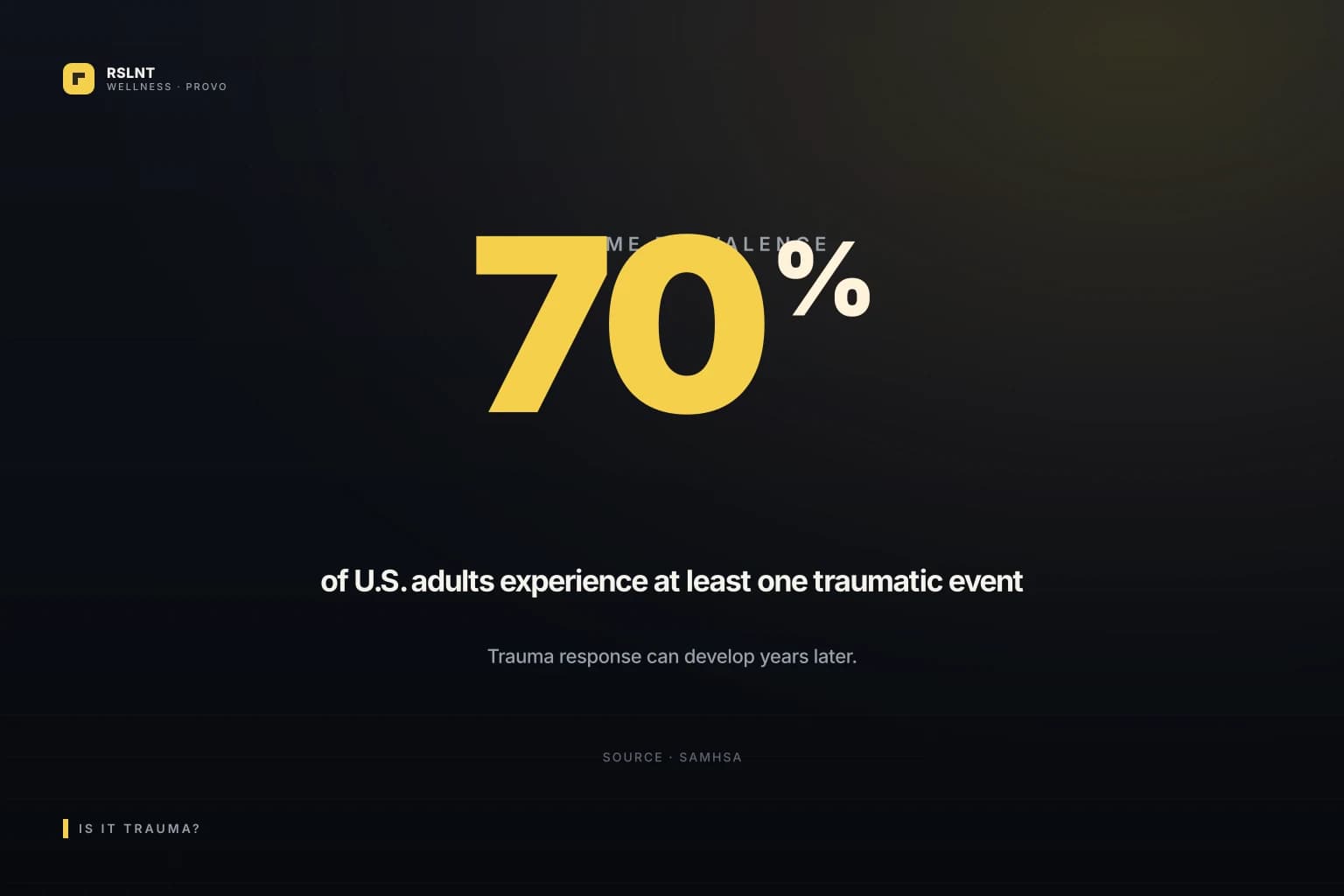
Table of contents
Here's the part nobody tells you. The reason you keep wondering whether you have trauma is usually the answer.
People who don't have trauma don't lie awake asking the question.
To know if you have trauma, ask yourself three things. Does your past show up in your body before your brain catches up? Do certain situations leave you bracing when nothing has actually happened? Has the way you protect yourself started costing you the closeness you want? If yes to even one, something happened that your nervous system hasn't finished filing away. That counts.
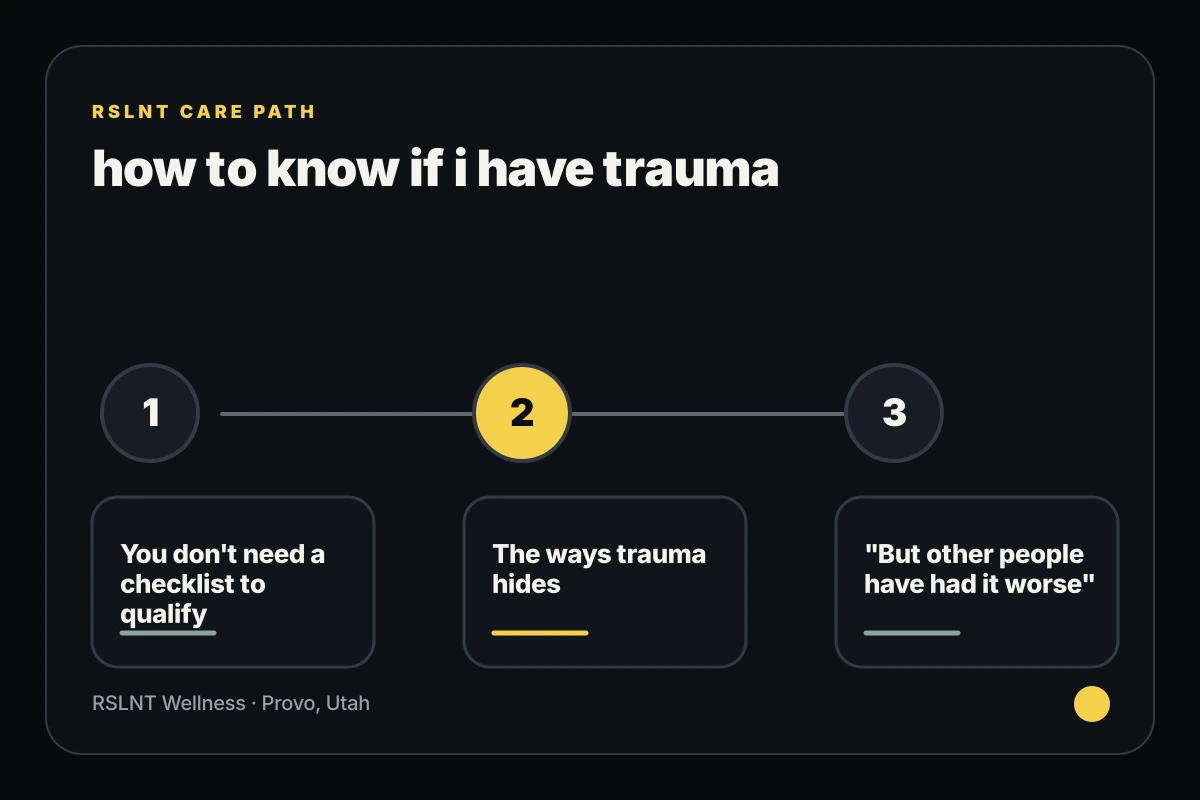
You don't need a checklist to qualify
The clinical definition of trauma keeps moving. The DSM-5 lists specific event types. Researchers like Bessel van der Kolk and Gabor Maté argue that the impact matters more than the category. The American Psychological Association now uses the word more broadly, recognizing that a steady drip of stress can rewire a brain just like a single shocking event.
You don't have to qualify on someone else's chart. You qualify when something that happened to you, big or small, is still steering your reactions today.
That's the only test that matters in the room.
The ways trauma hides
A lot of people picture trauma as flashbacks or nightmares. Those are real symptoms, but they're not the most common ones we see.
The quieter signs:
- You apologize for things that weren't your fault
- You shrink in the presence of certain personality types
- You can't tolerate being misunderstood, even on small things
- You go cold when someone raises their voice
- You overthink texts before sending them
- You can't relax until everyone around you is calm
- You explain yourself when no one asked
These look like personality traits. Sometimes they are. Sometimes they're scar tissue.
"But other people have had it worse"
This is the sentence that keeps people stuck for years. Maybe a decade.
Comparison is not a diagnostic tool. Your nervous system did not get the memo that your story isn't as bad as someone else's. It just registered what happened to you, locked the threat in, and started running the program.
According to the National Institute of Mental Health, around 70 percent of U.S. adults experience at least one traumatic event in their lifetime. Most of them never call it that. Most of them keep functioning. Most of them also wonder why they feel a little off, a little tired, a little tense, for years.
Other people having it worse doesn't make what you carry weigh less.
What an honest answer sounds like
If you're trying to figure this out alone, try writing down a single sentence: Something happened. It still affects me.
If you can't put a face on it yet, that's fine. Sometimes the body knows before the brain remembers. Something happened is enough to start a conversation with someone who can help.
You don't owe anyone the full story to ask for support. You only owe yourself an honest first sentence.
What we look at when you walk in
A trauma assessment isn't a quiz. It's a conversation about how your life feels from the inside. We want to know:
- What does a hard day look like for you right now?
- What kinds of situations spike your body, even when you logically know they're safe?
- Where in your life are you working too hard to look fine?
- What's the cost of keeping it all together?
We're listening for patterns, not labels. The label, if it ever lands, comes much later.
How we actually treat this at RSLNT
At RSLNT Wellness, trauma work is patient work. We don't rush you toward the worst memory. We start with stabilizing the ground.
Counseling that respects the nervous system. Our clinicians use trauma-focused CBT, EMDR, and acceptance and commitment therapy. The right tool depends on you, not on a manual.
Medication management for the symptoms making everyday life harder. SSRIs like sertraline and escitalopram, SNRIs like venlafaxine, and prazosin for trauma-driven nightmares are all on the table when they fit. We don't push pills. We don't withhold them either.
TMS therapy when depression rides on top of the trauma. TMS is FDA-cleared and uses gentle magnetic pulses to wake up the part of the brain that handles mood. Many of our trauma patients need depression treated first so they have the energy to do the deeper work. Six weeks of sessions, no anesthesia, no needles, no recovery.
You don't have to bring a perfect story to the door. You just have to come.
Frequently asked questions
What if I'm not sure anything bad enough happened?
Then start with a conversation about how you feel today. Trauma is what your body kept, not what the timeline says. A clinician can help you sort through what's running in the background.
How long does trauma treatment take?
That depends on the depth and how long it's been there. Some patients see meaningful shifts in 8 to 12 weeks of focused therapy. Deeper or more layered work takes longer. We don't oversell timelines we can't promise.
Will I have to talk about everything that happened?
No. Modern trauma therapy is designed to keep you in your window of tolerance. You don't have to relive anything. You don't have to share details before you're ready. The work happens at your pace.
You can take the first honest step today
If something old is still steering your day, a short call can tell us a lot.
Schedule a free 15-minute consult. We'll ask a few questions, listen, and tell you whether what you're describing fits something we treat. No diagnosis on the phone. No pressure.
I'm not a therapist or a doctor. I'm someone who went from suicidal ideation, major depressive disorder, and crippling anxiety to clarity of mind. I feel like I got my life back. RSLNT Wellness is the place that helped me get there. If you're struggling, you don't have to figure this out alone.
Frequently Asked Questions
What if I'm not sure anything bad enough happened?
How long does trauma treatment take?
Will I have to talk about everything that happened?
Sources & Further Reading
Every clinical claim in this article is backed by a public, peer-reviewed, or government source. We do not cite anything we cannot link to.
- [1]Post-Traumatic Stress Disorder - National Institute of Mental Health (NIMH)National Institute of Mental HealthBacks: PTSD can develop after experiencing or witnessing assault, abuse, accidents, disasters, or other serious events.
- [2]Post-Traumatic Stress Disorder - National Institute of Mental Health (NIMH)National Institute of Mental HealthBacks: PTSD can cause people to feel stressed or frightened even when they are no longer in danger.
- [3]Post-Traumatic Stress Disorder - National Institute of Mental Health (NIMH)National Institute of Mental HealthBacks: PTSD symptoms can include nightmares, flashbacks, avoidance, being on edge, and sleep or concentration problems.
- [4]Treatments for PTSDAmerican Psychological AssociationBacks: Trauma-focused CBT is an evidence-based treatment used for PTSD.
- [5]Eye Movement Desensitization and Reprocessing (EMDR) TherapyAmerican Psychological AssociationBacks: EMDR is a structured therapy using bilateral stimulation while focusing on trauma memories.
- [6]Cognitive Processing Therapy (CPT)American Psychological AssociationBacks: Cognitive processing therapy helps patients modify and challenge unhelpful beliefs related to trauma.
- [7]Transcranial magnetic stimulation - Mayo ClinicMayo ClinicBacks: TMS is a noninvasive procedure that uses magnetic fields to stimulate nerve cells in the brain.
- [8]510(k) Premarket NotificationU.S. Food and Drug Administration · 2008Backs: The NeuroStar TMS Therapy System was FDA-cleared in 2008 for major depressive disorder.
Ready to feel like yourself again?
Schedule a free consultation to see if TMS therapy is right for you.
Book Your Consultation